Thermal Plasma Spray and Residual Stress
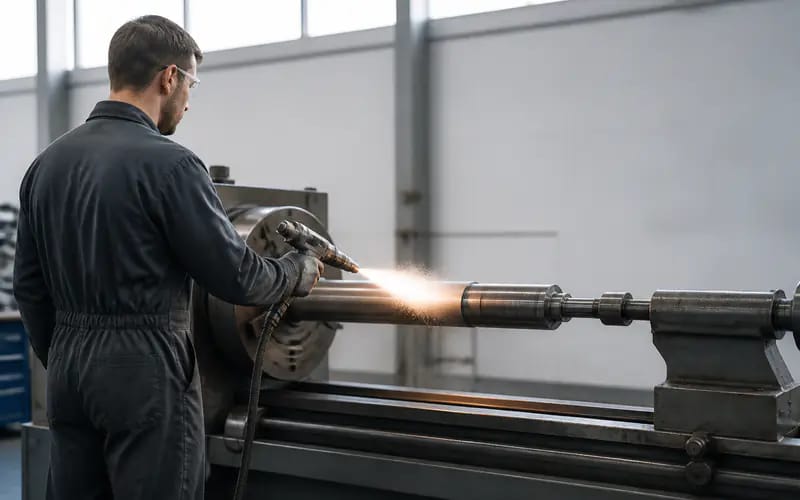
Residual stress is an important consideration in Thermal Plasma Spray coatings.
All sprayed coatings contain some residual stress once they have cooled down. The amount and type of residual stress as well as its origin all can affect the durability of a coating.
What Residual Stress Actually Means
Residual stress is the pressure of tension or compression that remains in a coating after it has cooled down to room temperature. This stress originates from two causes of stress: the quenching stress that is produced by the rapid solidification of a droplet and the subsequent mismatch stress that develops as the coating and the substrate (support) contract upon cooling down at different rates. This stress is locked into the coating whether it is visible or not. It can appear weeks after the coating has been applied and appears to develop seemingly without warning.
Why The Build-Up Process Creates Stress
The many, very small molten droplets, splats, in a sprayed coating, flatten and solidify very fast, typically within a millisecond or so. As each splat solidifies it tries to shrink as it cools but is restricted by the bond with the solidifying layer below. This shrinkage which is not allowed to occur is converted into stress. All of these stressed layers are stacked on top of each other in a thick coating and can easily total up to a lot of stress in the coating. This is in contrast to a coating of very small thickness where all the stressed layers can easily relax and thus the coating is able to carry a lot of stress without failing.
How Thickness Changes The Risk
As a coating builds up in thickness, all of these stressed layers are piled on top of each other. The stress in a coating of 0.1mm thickness may be perfectly acceptable, whereas a coating of the same material applied to the same part to a thickness of 0.5mm can develop so much internal stress that it eventually exceeds the strength of the coating or adhesion and leads to cracking or spallation. In most instances, coatings are specified with a maximum recommended thickness to prevent such problems occurring.
Why Material Mismatch Adds Extra Stress
All engineering materials change in dimensions with changes in temperature. This is described by a parameter known as the thermal expansion coefficient and is a characteristic of a material. For example a ceramic coating sprayed to a steel substrate has a thermal expansion coefficient for ceramics and for steel. On cooling down from the spray temperature to room temperature the steel will shrink more than the coating and thus pull the coating into tension. This is additional to the quenching stress that has been induced in the coating during the spraying process.
Controlling Substrate Temperature
Preheating the part prior to application, and interpass cooling, are two simple ways to reduce the heat input to the part being coated. If a part is sprayed ‘cold’ from the shop floor, each pass will give a large temperature change in the coating and the substrate, whereas if the part is preheated to a controlled starting temperature, the temperature change per pass will be much less. Interpass cooling allows the surface to return to the pre-set temperature before the next layer is applied. This prevents the part’s surface temperature from building up layer by layer until it is running too hot.
How Spray Parameters Affect Locked-In Stress
Torch power, spray distance and traverse speed affect the part temperature and the solidification rate of the coating layers. By increasing the part temperature and thus the solidification rate of the coating layers, the stress generated by quenching can be increased. To achieve a suitable bond between the splats, the spray distance and traverse speed must be selected so as to avoid solidification before the splats have joined up. This is critical in achieving a successful spray finish. Controlling the heat input into the part during the Thermal Plasma Spray process is crucial and must be addressed on an individual coating/substrate basis with the coating material.
Warning Signs Worth Checking For
High residual stress in a coating can lead to early coating failure. A thin edge or section of a coated part may develop unusual flatness. Surface cracks of the thinnest of lines may appear over time. The coating may ‘delaminate’ or flake off at edges, particularly at corners. This type of coating failure can take some time to develop and become visible and, indeed, often becomes visible after a few days and following a temperature cycle. Ensure edge areas and thin sections of coating are inspected carefully for signs of coating failure after spraying.
Managing And Checking Stress Before Release
Parts can be fixed in place to prevent distortion while they are cooling down. Once cooled they can be checked against their drawings to see if they have been affected by any distortion. Some very sensitive components are even subjected to stress-relief heat treatment prior to use in order to reduce any residual stress in the coating or deposited material. The underlying material science of sprayed and deposited coatings and their residual stress is well documented and this is how such stress is controlled.
Stress in coatings cannot be totally removed and has to be contained within given limits. By choosing a suitable preheating concept and appropriate spray parameters and by checking for stress the coating can last for a long time rather than fail very quickly.